 Speech models
 Voice agents
 Logistics systems
 Sensors
 Security and compliance
 Medical transportation
 Public transit
 Freight
 About
 Open roles
 Contact
 Support
 Articles
October 28, 2026 · 3 min read
A speech model trained by listening
Block's new voice model learned to talk from sound alone. The interesting question is whether it learned when to speak.
On October 23, Block’s research lab introduced Dessa, a speech model that “listens and talks at the same time, like you do.” Block says it trained Dessa “from scratch on nothing but human conversation. Sounds! No text, no pretrained models,” and that it “knows when to cut in and when to backchannel.” There is no paper yet, only a page of 21 recordings handpicked by Block. However, this is still one of the most interesting problems in voice AI.
Wren is listening
Two tracks
A conversation is two tracks of sound, one for each speaker. People overlap, pause in the middle of a sentence and say “yeah” while the other person is still talking. A transcript flattens all of it into one line of words, and the timing is gone.
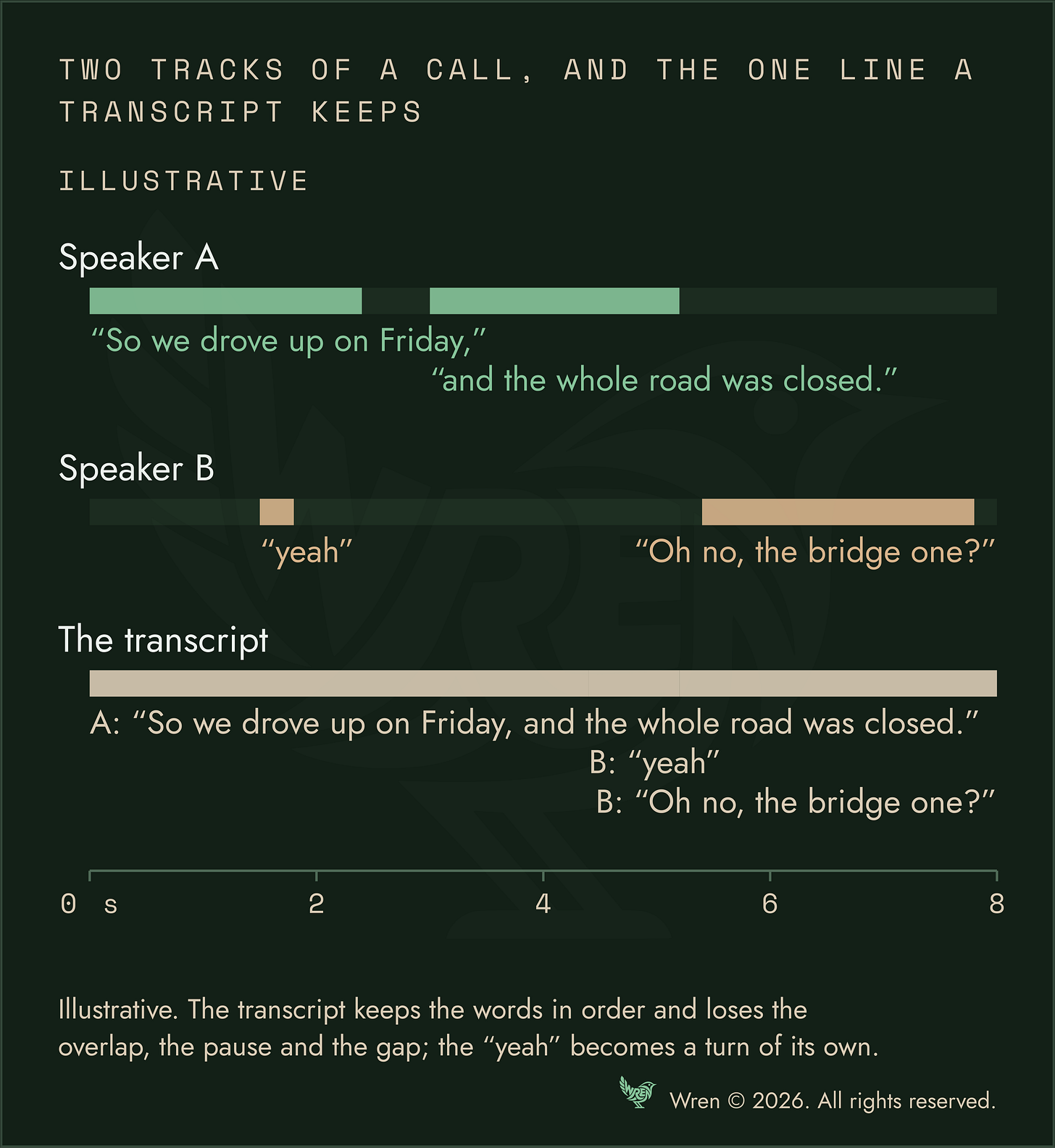
Most voice agents are built around transcripts, so they need another rule for when to speak. Usually it is a silence timer: once the person has been quiet long enough, the agent answers. Dessa keeps both tracks and decides, moment by moment, whether to make a sound.
When to speak
People are fast at this. The gap between one speaker stopping and the next starting is typically 100 to 200 milliseconds, yet preparing even one word takes around 600. The linguists Stephen Levinson and Francisco Torreira argue that a listener plans the reply while the other person is still talking and predicts when the turn will end. Silence would mislead them anyway, since a pause inside a turn is often longer than the gap between turns.
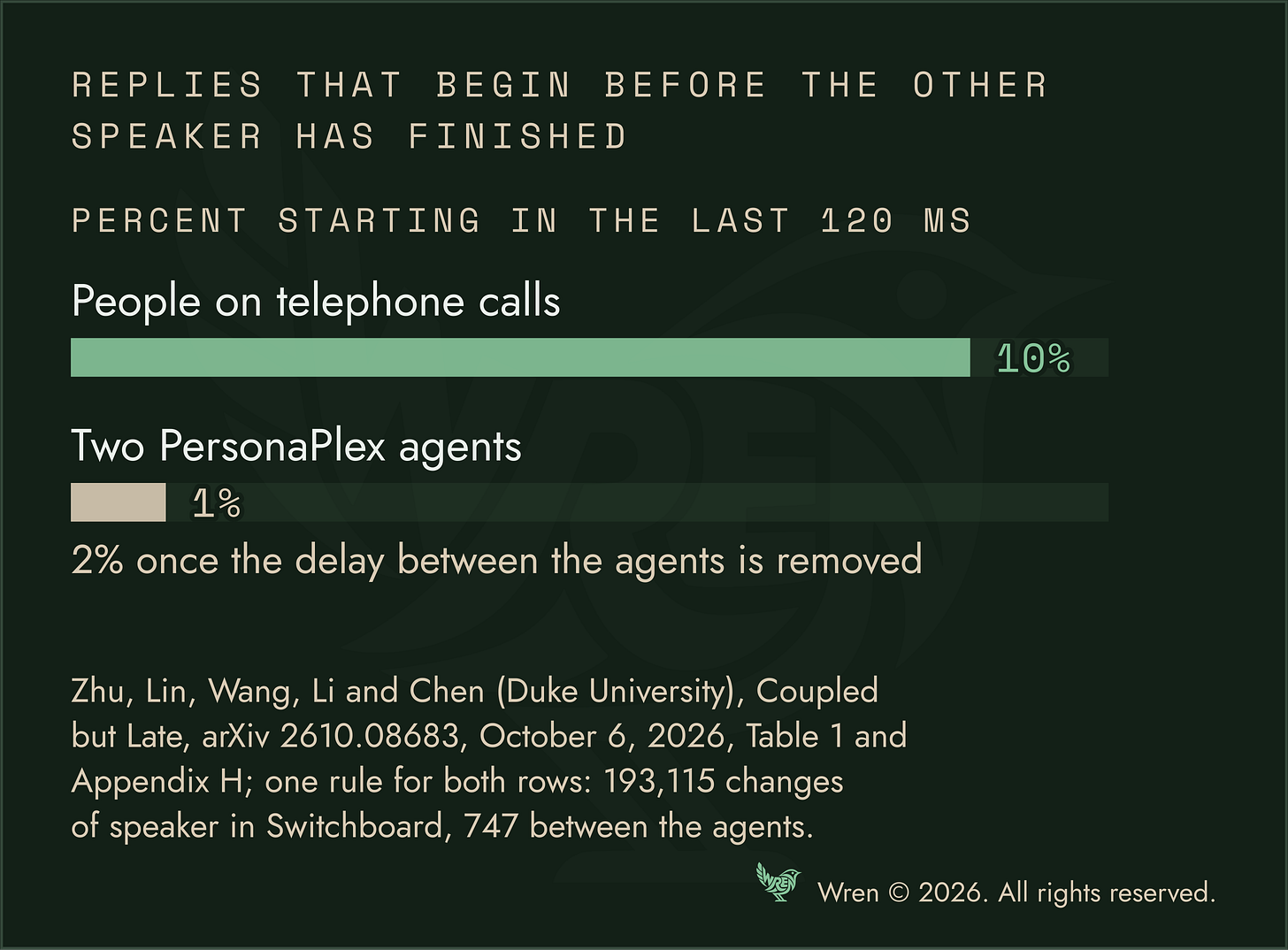
Current full-duplex models find this hard. In October, researchers at Duke set two copies of NVIDIA’s PersonaPlex, another full-duplex model, talking to each other. On telephone calls, people start one reply in ten in the last 120 milliseconds of the other’s turn, before it has ended; the agents started one in a hundred. The authors read this as waiting for the other to stop rather than predicting the end.
We have attempted to train models based on audio only before. In 2022, dGSLM, trained on telephone calls, produced dialogues whose turn-taking listeners rated far more natural than a text pipeline’s, but by it lacked “the ability to produce semantically coherent speech.” Most full-duplex models since, PersonaPlex among them, have a text language model inside, the kind behind ChatGPT.
Dessa thinks it can do without a text model entirely.
Our view
-
Knowing when to speak is a prediction, not a detection. A model that waits for silence answers late, and long pauses inside a turn keep tricking it into speaking. We’d be interested in timing Dessa’s replies and see whether, like people, it starts some replies before the other participant has finished speaking.
-
Voice carries information beyond words. People choose their words; their pitch, pace and strain move with how they feel, whether they mean them to or not. A model that works from a transcript gets only the words. A model that learned only from sound has no transcript to lean on, so it may hear the difference.
-
Real calls are noisy. A phone line carries a narrow band of sound, and there may be a television on in the room. Silence timers fail in noisy environments. A model that predicts the end of a turn does not rely on silence.
What we would like to see
Block’s page asks how efficiently a model like this learns language compared with text. Answering that takes numbers rather than recordings:
-
How many hours of conversation Dessa heard?
-
Whose voices they were?
-
How its timing compares with real calls?